Finishing the endurance - Is it getting harder?
September 28, 2024
Reliability is probably one of the most common goals in Formula Student. After all, there’s the old saying in motorsport “To finish first, first you have to finish”. On the other hand the endurance is still the hardest test of any event and every year there are lots of broken dreams (and whishbones) on the final day. So I asked myself, if the number of finishers is getting more as teams learn from their mistakes to build a more robust car or if it is getting less as cars get more complex over the years. To answer this I looked at the percentage of teams finishing the FSG endurance compared to teams that are registered for the event. This statistic includes therefore also teams that did not get through scrutineering or were disqualified in post-scruti, which may not be strictly related to reliability. However, I think having fluid systems without leakage, aero that is not flexing, secured bolts and properly working electronics are signs of a reliable car and often times the problems in scruti arise from one of these properties missing.
How many teams are finishing the endurance on average?
About 40%. Of the 1625 cars brought to a FSG event between 2006 and 2024 601 finished the endurance, equivalent to 36,98%. This means if your car always finishes an endurance and then loses its suspension at the next event you are well above average. Ok, but now let’s look at the percentages over time:
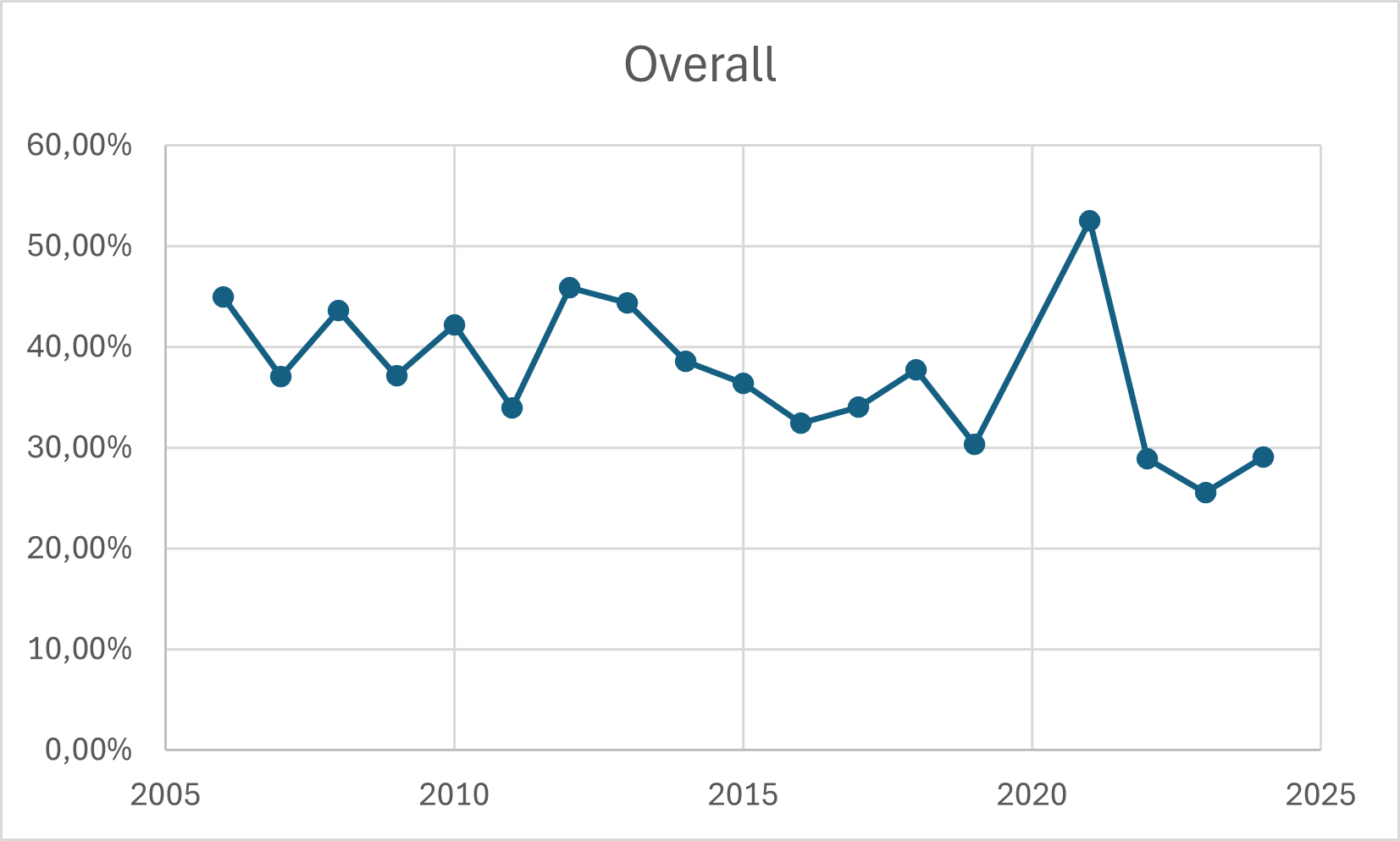
In the beginning the numbers vary a bit, because of the smaller number of participants and from a high in 2012 and 2013 it was a pretty steady decline only broken by the event in 2021, which I will go into later.
One big factor to consider is the different number of EVs and combustion cars each year. The first event with EVs was 2010 with a increasing number over the years until finally the combustion cars were completely eliminated in 2024. So here is another graph splitting the two classes.
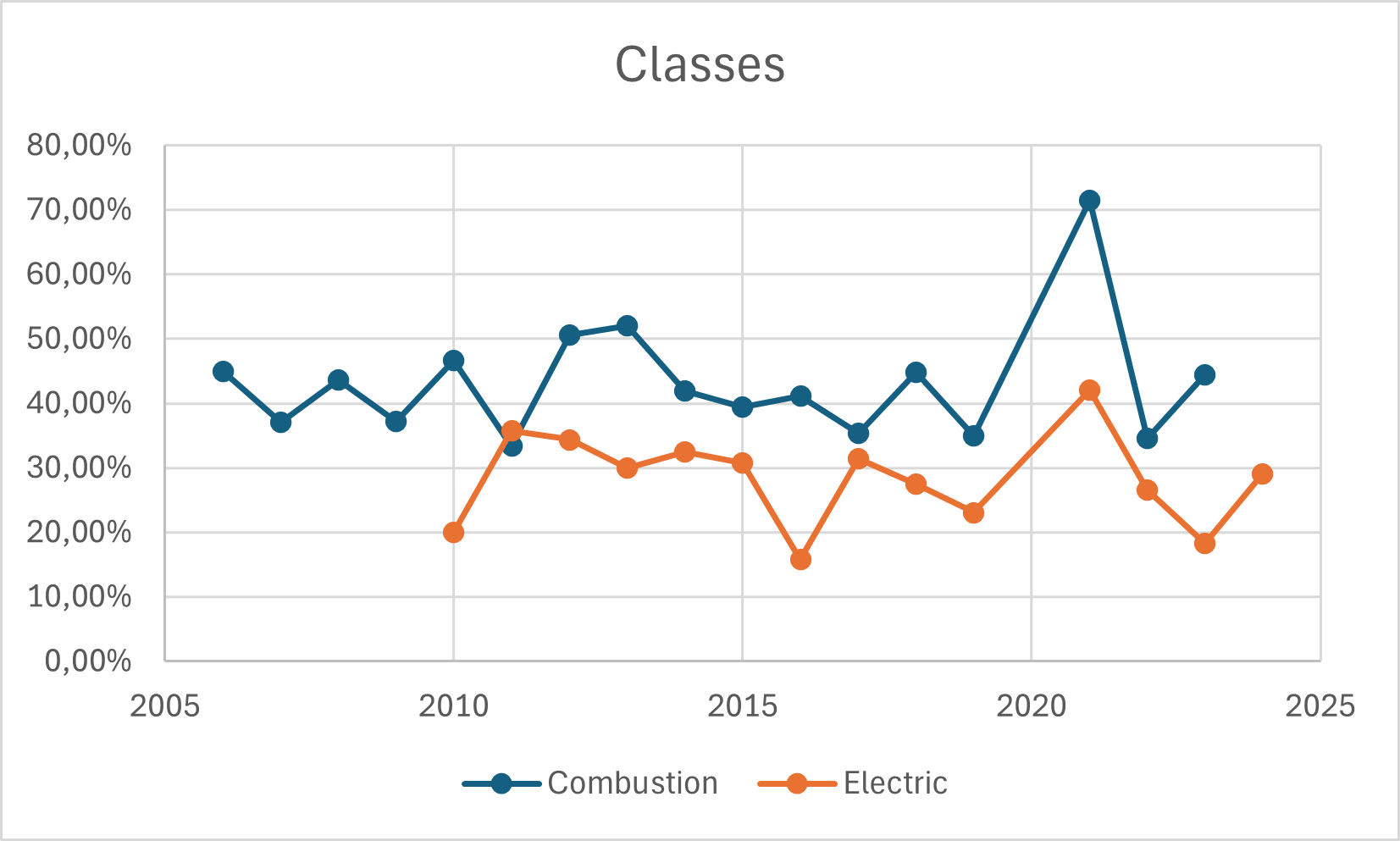
In general, the combustion cars were more reliable than the electric ones except for 2011 where they had their worst year. There’s no clear trend up or down, which means in general teams were not able to make their cars more robust in the 13 years, where the class existed.
For EVs your chances of seeing the checkered flag are even more slim. The average over the years is 27,93%. Which means if you go to three events, lose a wheel at the first one, finish
the second and short circuit your battery at the third, you had an above average season. In 2016 only 6 out of 38 EVs finished. And the trend seems to point downward. Before 2016 5 out of 6 events had a rate of 30% or above, while after 2016 only 2 out of 7 events achieved this.
Many feared the integration of the driverless disciplines into the electric category in 2022 would lead to even more complexity and a lower rate of finishers. If you were one of those you
could take FSG23 as confirmation with the worst rate since 2016, but 2022 and 2024 were pretty average. So in my opinion it is too early to see an impact.
How does this compare to other forms of motorsport?
Some interesting point of comparison is Formula 1, which saw the introduction of hybrid systems in 2014, rules on the team budget and limits on the number of parts to use in a season. Despite this, according to an article from racefans.net, this season is likely to be the one with the most finishers ever. Their data also shows a steady increase in finishers from the 1992 season with 45% to a rate of almost 90% today. In the Le Mans 24 hours, where the top finishers usually complete a distance of 200 FSG endurances, the percentage of finishers between 2013 and 2017 was at record highs. According to the ACO around 70% of starters finished the race. So Formula student seems to run contrary to an overall trend of more reliable racecars, which poses the question, if FS teams could also reverse this trend?
How do you make a car more reliable?
There are people more qualified than me to answer this question. My personal record is around 46%, but nowhere near the reliability of Rennteam Stuttgart between 2011 and 2019 (95%) or ETH Zürich between 2011 and 2018 (86,7%). But even they experienced seasons with no finishes.
In my opinion the amount of innovation, self-developed parts and “high-tech” in a car does not impact reliability as much as people think. The two teams I just mentioned were at times the
most reliable, while also being the fastest and bringing innovations to the competition. I think that the biggest challenge is learning from previous years and keeping the knowledge inside
the organization. This could be achieved by a strong Alumni network, good documentation or people staying for multiple seasons. If a team focuses on eliminating their weak points and
keeping the parts that were good, I would guess that their reliability would improve steadily.
But for the most important factor in my view, let’s look again at the one exception in the statistic. In 2021 FSG was held under exceptional circumstances. After the event 2020 was cancelled due to COVID, the event in 2021 was smaller both in the number of teams (21 CVs, 38EVs) as well as the size of the teams with a limit of 8 participants per team, including drivers, ESOs and everyone else you would need. Despite this the rate of finishers was by far a record for both classes: 42% for EVs and a staggering 71% for CVs! To me this suggests that testing time and finishing your car early is the most important factor to finish the endurance. In 2020 after the events were cancelled a lot of teams decided to finish their 2020 car early and focus on testing and event preparation during the 2021 season.
In conclusion my advice is to test often and early under event conditions. Seek out the weaknesses of the car and fix them systematically. A simplified design can help to achieve this, because the design phase can be shorter, but don’t fear to completely redesign parts that made problems in the last season. Also analyse the problems of earlier seasons and document your own.
Good luck!